
author
Miriam Davoudvandi
Miriam Davoudvandi was born in Bucharest in 1992 to a Romanian mother and an Iranian father and grew up in a small town in southern Germany. She is a freelance journalist, moderator, and author, has received multiple awards, and hosts the WDR podcast »Danke, gut« (Thanks, I’m fine), in which she speaks with public figures about mental health. She began her journalistic career writing about rap music and later became editor-in-chief of a hip-hop magazine. Today, her work on pop culture, politics, and mental health appears, among others, in Der Spiegel and Die Zeit. She has also written for the stage (»It’s Britney, Bitch!«, Berliner Ensemble). Her essay »Unlearn Mental Health« was published in the bestselling anthology »Unlearn Patriarchy II«.
© Daniel Nguyen
Latest book
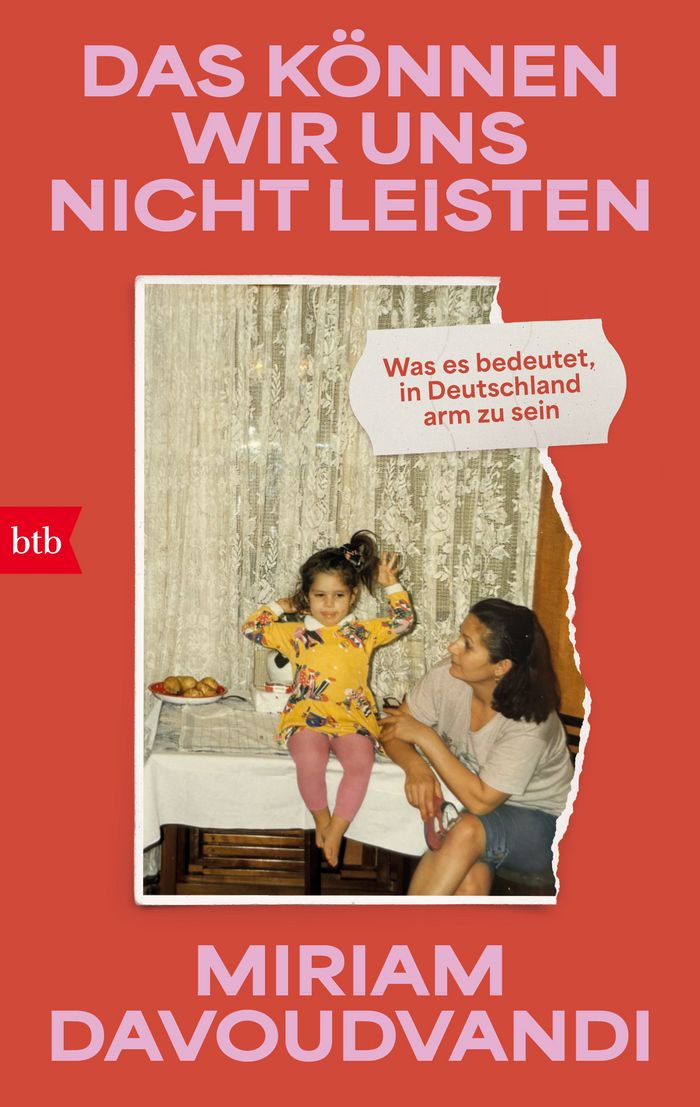
Das können wir uns nicht leisten (We Can’t Afford That)
btb Verlag
For a long time, she avoided boys, because Miriam Davoudvandi knew that sooner or later every guy would see the inside of her apartment: the shabby social housing block surrounded by single-family homes, the cluttered rooms, the worn-out bathroom. The shame of having nothing to offer and not belonging had shaped her at least since she started school – and it remains part of her to this day.
She has since achieved upward social mobility and now earns more than her parents ever did. Her conclusion: money can indeed make you very happy. But at what price? And what traces have her experiences left behind? Honest and moving, Miriam Davoudvandi recounts what it means to be poor in Germany. She looks not only at the obvious sites of poverty, but also at aspects such as dating, friendships, starting a family, and mental health; at the significance of the television set and what it means to be the first in the family to attend university. And she shows why the poor are disadvantaged even in death.
Poverty may be measurable. But numbers do not help us understand what poverty feels like or what it does to people in the long term. All the more important, then, to hear Miriam Davoudvandi’s story. She also speaks for all those who have not yet had a voice.
- Previous authors
- All authors
- Next authors »
